
The Real Question Every Cat Owner Faces
If you have a cat, you already know the 5 a.m. wake-up call. The insistent paw on your face. The yowling that somehow gets louder the longer you ignore it. Feeding time is sacred to your cat, and completely non-negotiable.
The debate around automatic feeder vs manual feeding cat is one that more pet owners are taking seriously, and for good reason. Our lives are busier than ever, our cats are living longer, and the connection between consistent feeding schedules and feline health is better understood now than it has ever been.
This guide is not about telling you that one approach is universally right. It is about helping you understand what each method actually looks like in real life, what your cat experiences on both sides, and how to make the choice that genuinely fits your household. By the end, you will have a clear picture of which path makes the most sense for you.
Manual Feeding: An Honest Look at the Reality
Manual feeding is the default for most cat owners. You scoop the food, you put it in the bowl, your cat eats. It sounds simple, and in many ways it is. But there is more nuance here than most people acknowledge.
The Genuine Benefits of Feeding Your Cat by Hand
There is real value in the daily ritual of feeding your cat yourself. That moment when you open the cabinet, hear the bowl hit the floor, and watch your cat trot over with their tail straight up in the air, it is a bonding moment. Cats are creatures of habit, and many do form positive associations with the person who feeds them.
Manual feeding also gives you a built-in health check every single day. When you are the one putting food in the bowl, you notice immediately if your cat is not eating. A skipped meal is often the first sign that something is off, and catching that early can make a meaningful difference in your cat's health outcomes.
For cats with complex medical needs, manual feeding gives you precise control. You can adjust portions based on how your cat looked that morning, add medication directly to the food, or switch between wet and dry food with full flexibility.
Where Manual Feeding Falls Short
Here is where the honest conversation gets uncomfortable. Manual feeding depends entirely on you being present, alert, and consistent, and that is a high bar to clear every single day of the year.
Most cat owners who feed manually do not actually feed at the same time every day. Weekday schedules differ from weekends. Late nights happen. Travel comes up. Each of these disruptions sends a small ripple of stress through your cat's day, because cats are genuinely sensitive to routine changes in ways that are easy to underestimate.
Expert Insight: Veterinary behaviorists consistently note that irregular feeding schedules are a common but overlooked source of anxiety in domestic cats. A cat that never knows exactly when food is coming will often become food-obsessed, vocal, or prone to overeating when food does appear.
There is also the portion problem. When you are tired, rushed, or simply eyeballing it, portions drift. Over weeks and months, that drift adds up to real weight gain or, in some cases, underfeeding. Feline obesity is now one of the most common preventable health issues in domestic cats, and inconsistent portioning is a major contributor.
The Emotional Weight of Manual Feeding
Nobody talks about this part, but it is worth naming. When you are the sole source of your cat's food, every trip, every long workday, every social event comes with a layer of guilt or logistical stress. Who will feed the cat? Can I stay out late? Should I rush home?
That low-level anxiety is real, and it affects how freely you live your own life. It also affects your cat, who picks up on your stress more than you might realize.
What Automatic Feeders Actually Do for You and Your Cat
The phrase "automatic feeder" covers a wide range of devices, from basic gravity-fed bowls that just let food pour out freely, to genuinely smart systems that let you schedule meals, control portions precisely, and check in on your cat from anywhere in the world. Understanding what the better end of that spectrum looks like changes the conversation entirely.
The Gift of a Consistent Schedule
A quality automatic feeder does one thing better than any human can: it is perfectly consistent. It does not sleep in on Saturday. It does not get stuck in traffic. It does not forget because a meeting ran long. Your cat gets fed at the same time every single day, which is exactly what their biology is asking for.
That consistency has measurable effects. Cats on regular feeding schedules tend to be calmer, less food-focused between meals, and easier to manage overall. When a cat knows that food is coming at 7 a.m. and 6 p.m. without fail, they stop treating every waking moment as a potential famine. The midnight yowling often decreases significantly within the first week of switching to a scheduled feeder.
Portion Control as a Health Tool
Modern automatic feeders dispense exact, pre-set amounts of food at each meal. This is not just a convenience feature. It is a genuine health intervention for a huge number of cats.
If your cat has been gaining weight, if your vet has recommended a specific daily calorie target, or if you have a multi-pet household where one cat tends to eat faster and steal from the others, precise portioning changes the game. You set the amount once based on your vet's guidance, and the feeder handles the rest with no drift, no guesswork, and no guilt.
Remote Feeding and Peace of Mind
The most meaningful upgrade in modern automatic feeders is connectivity. WiFi-enabled feeders let you trigger a meal from your phone, check that the feeder is working properly, and in many cases, see your cat via a built-in camera while you are away. That last feature sounds like a novelty until the first time you are at a work conference three states away and you get to watch your cat trot up to the bowl, eat their dinner, and curl up satisfied. The relief that comes from that moment is hard to overstate.
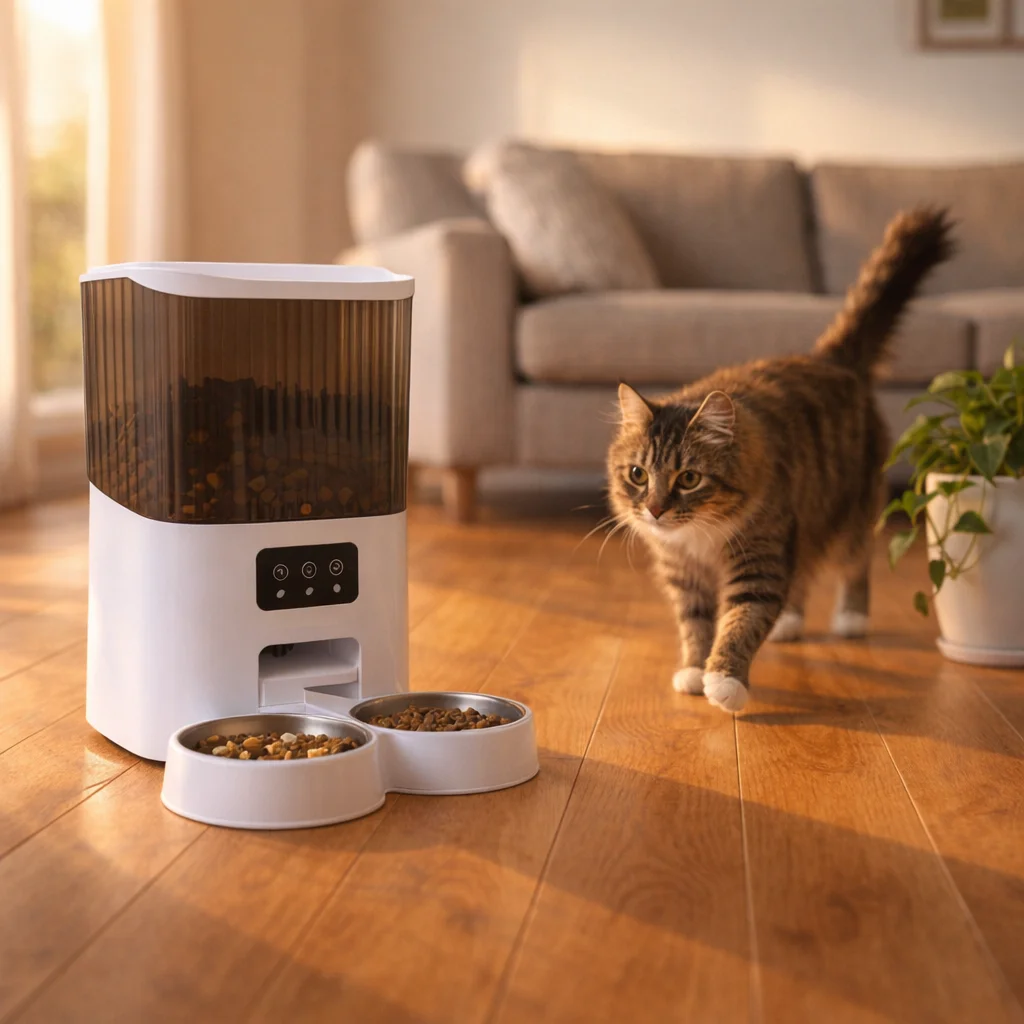
A feeder like the Pawvision 5L Smart Pet Feeder brings all of these elements together. Scheduled meals, precise portions, live camera access, and WiFi connectivity mean that your cat is cared for consistently whether you are in the next room or on a different continent.
Automatic Feeder vs Manual Feeding Cat: A Side-by-Side Breakdown
Let us look at the most important dimensions of this decision honestly, without sugarcoating either side.
Consistency and Reliability
Manual feeding is only as consistent as you are. For most people, that means it is fairly consistent during the week and less so on weekends, holidays, or any time life gets complicated. Automatic feeders are consistent by design. Once programmed, they do not vary.
Winner for consistency: automatic feeders, without question.
Health and Portion Management
Manual feeding gives you flexibility to adjust on the fly, which matters for cats with complex or changing medical needs. But for the majority of healthy cats, that flexibility is more often a liability than an asset, because it leads to inconsistent portions.
Automatic feeders with programmable portions take the human error out of the equation. If your vet says your cat should have 60 grams of food per day split across three meals, that is exactly what happens, every day.
Winner for most cats: automatic feeders. For cats with highly variable medical needs: manual feeding with careful attention.
Bonding and Relationship
This is where the conversation gets more personal. Many cat owners worry that an automatic feeder will somehow weaken their bond with their pet. The fear is understandable, but the evidence does not really support it.
Cats bond with their owners through play, through physical affection, through shared space, and through the general experience of being safe and cared for. The bowl of food is a small part of that picture. Many owners who switch to automatic feeders report that their cats actually become more affectionate overall, possibly because the owner is no longer associated with the stress of an unpredictable feeding schedule.
That said, if the act of feeding your cat is something you genuinely cherish and look forward to, that matters. Your relationship with your pet is real and worth protecting.
Convenience and Lifestyle Freedom
Manual feeding requires you to be home, alert, and on schedule twice or more a day. Automatic feeding gives you genuine freedom. You can stay late at work, travel for a weekend, or simply sleep in without any consequence for your cat.
Winner for lifestyle flexibility: automatic feeders, by a wide margin.
Cost and Setup
Manual feeding costs nothing beyond the food itself. A quality automatic feeder is an upfront investment, though mid-range options now offer genuinely impressive features without a premium price tag. For most cat owners, the cost pays for itself quickly in reduced pet-sitting fees alone.
Who Benefits Most from Switching to an Automatic Feeder
Automatic feeders are not for everyone, but they are genuinely transformative for certain types of cat owners and certain types of cats. Here is how to know if you are in that group.
Cats Who Would Thrive with an Automatic Feeder
Cats who are overweight or prone to overeating are among the clearest candidates. When food is available at unpredictable times or in inconsistent amounts, many cats develop a habit of eating as much as possible whenever food appears. A scheduled feeder with precise portions breaks that cycle gently and effectively.
Cats who wake their owners up early for food, a behavior so common it has its own name among cat owners, almost always improve dramatically with a scheduled feeder. When the machine dispenses breakfast at 6:30 a.m. every morning, the cat learns to wait for the machine, not to wake you up. The change can happen within a week.
Senior cats also benefit enormously. Older cats often need smaller, more frequent meals to support digestion and maintain a healthy weight. An automatic feeder can handle four or five small meals per day without any additional effort from you.
Owners Who Would Benefit Most
If you work long or unpredictable hours, an automatic feeder removes a genuine source of daily stress. If you travel regularly, even just overnight, the peace of mind that comes from knowing your cat is fed on schedule is significant. If you have been told by your vet that your cat needs to lose weight or maintain a specific diet, a feeder with precise portion control is one of the most effective tools available to you.
Even if you are home most of the time, the freedom of not being tied to a strict feeding schedule has real quality-of-life value. You can go to a late dinner, take a weekend trip, or simply not feel guilty about sleeping in on Sunday morning.
Situations Where Manual Feeding May Still Be Best
If your cat eats primarily wet food, most standard automatic feeders are not designed for that. Wet food spoils quickly at room temperature, and most feeders are built around dry kibble. Some owners use a hybrid approach, using an automatic feeder for dry food during the day and manually providing wet food in the evening.
If your cat is managing a complex illness that requires frequent medication adjustments or highly variable feeding protocols, the flexibility of manual feeding may still be valuable. In these cases, talking with your vet about the best approach is always the right first step.
How to Make the Transition Smoothly
Switching from manual feeding to an automatic feeder is not complicated, but doing it thoughtfully makes the process easier for both you and your cat.
Start with Your Cat's Current Schedule
Do not introduce the feeder and change the feeding times simultaneously. Start by programming the feeder to dispense food at the same times you currently feed manually. Your cat will begin associating the sound of the feeder with mealtime, and that association forms quickly, usually within just a few days.
During the first few days, sit near the feeder when it dispenses food. Your presence reassures your cat that this new object is safe and trustworthy. After a few sessions, most cats approach the feeder confidently on their own.
Introduce the Device Before You Rely on It
Set up the feeder and let your cat explore it before you actually use it for feeding. Let them sniff it, investigate it, and decide it is not a threat. Cats are naturally cautious about new objects in their territory, and giving them time to accept the feeder before it becomes part of their routine reduces the chance of hesitation when it matters.
Pro Tip: Place a small treat near the feeder on the first day, then on top of it on the second day, and then inside the bowl on the third day. This gentle approach builds positive associations without any pressure.
Monitor and Adjust During the First Two Weeks
Watch your cat's behavior and body condition during the first couple of weeks. Are they finishing every meal? Leaving food behind? Seeming hungrier than usual between meals? These observations help you fine-tune the portion size and meal timing to match your specific cat's needs.
Most automatic feeders with app connectivity make this easy, since you can adjust schedules and portions from your phone without touching the device itself.
What to Look for When Choosing an Automatic Feeder
Not all automatic feeders are created equal. The difference between a basic gravity feeder and a genuinely smart device is enormous, and understanding what matters most helps you make a choice you will be happy with long-term.
The Features That Actually Matter Day to Day
Programmable meal times and portion sizes are the foundation. Without these, you do not really have a feeding solution, you just have a bowl that refills itself. Look for a feeder that lets you set multiple meals per day with individual portion amounts for each one.
A large food capacity matters more than most people realize at first. A feeder that holds several days worth of food means you are not refilling it constantly, and it gives you genuine flexibility when your schedule gets unpredictable.
The food contact surfaces deserve attention too. Stainless steel bowls are far easier to keep clean and hygienic than plastic, and they do not harbor the bacteria or cause the chin acne that plastic bowls are known to trigger in sensitive cats.
Why Camera Connectivity Changes Everything
A built-in camera might sound like an optional extra, but for anyone who travels or works long hours, it becomes one of the most-used features almost immediately. Being able to see that your cat is eating well, that the feeder is functioning properly, and that your pet is happy and active at home provides a level of reassurance that is genuinely hard to put a price on.
The Pawvision 5L Smart Pet Feeder pairs scheduled feeding with live camera access and WiFi control, giving you the complete picture of your cat's day from wherever you happen to be. It is the kind of device that feels like a luxury until you use it for a week, and then it feels indispensable.
Reliability and Backup Options
Any device that your cat depends on for food needs to be reliable. Look for feeders that have backup power options in case of an outage, and check that the dispensing mechanism is designed to handle the kibble size your cat eats without jamming.
App reviews and real-world user feedback are your best guide here. A feeder that works perfectly in a controlled demo but jams regularly in actual use is not a solution, it is a problem waiting to happen at the worst possible moment.
Frequently Asked Questions
Will my cat still bond with me if I use an automatic feeder?
Yes, absolutely. Cats bond with their owners through far more than feeding. Play sessions, lap time, grooming, and simply sharing space all contribute far more to your bond than who puts food in the bowl. Many owners report that their cats become more affectionate after switching to an automatic feeder, likely because the owner is no longer associated with the stress of an unpredictable or delayed meal.
How do I know what portion size to program into the feeder?
Your veterinarian is the best starting point. Most vets can give you a daily calorie target based on your cat's age, weight, and activity level, and the food packaging will tell you how many calories are in each cup or gram of kibble. From there, you can calculate the right portion size and split it across however many meals you want to offer per day. Start slightly conservative and adjust upward if your cat seems genuinely hungry between meals.
What happens if the power goes out while I am away?
This is a valid concern and one worth checking before you buy any automatic feeder. Quality feeders often include battery backup options that keep the device running through a short outage. It is also worth having a trusted neighbor or pet sitter who can check in during an extended outage. WiFi-connected feeders will send alerts to your phone if connectivity is lost, which gives you an early warning if something is wrong.
Can I use an automatic feeder for wet food?
Most standard automatic feeders are designed for dry kibble. Wet food spoils at room temperature within a few hours, which makes it difficult to pre-load and schedule safely. Some specialized feeders include ice packs or refrigeration to handle wet food, but these are less common and more expensive. A popular middle-ground approach is using an automatic feeder for dry food during the day and manually providing a small wet food meal in the evening.
Is the automatic feeder vs manual feeding cat debate different for kittens?
Kittens under six months generally need more frequent meals and closer monitoring than adult cats, so manual feeding or a combination approach often makes more sense during that early stage. Once your kitten reaches adulthood and settles into a stable routine, an automatic feeder becomes a genuinely excellent long-term solution. Always check with your vet about the right feeding frequency for your kitten's specific age and growth stage.
The Bottom Line
The automatic feeder vs manual feeding cat question does not have a single right answer for every household. But for the majority of cat owners, especially those with busy schedules, cats prone to weight issues, or anyone who values genuine peace of mind when they are away from home, the case for a quality automatic feeder is compelling and practical.
Manual feeding has its place, particularly for cats with complex health needs or owners who genuinely treasure that daily ritual. But the honest truth is that most of us are not as consistent as we think we are, and our cats feel that inconsistency more than we realize.
A smart automatic feeder does not replace your relationship with your cat. It handles the logistical part of care so that the time you do spend with your pet can be about play, affection, and connection rather than rushing home to fill a bowl.
If you are ready to give your cat the gift of consistency and give yourself a little more freedom in the process, take a look at the Pawvision 5L Smart Pet Feeder. With scheduled meals, precise portioning, a built-in camera, and WiFi connectivity, it is the kind of upgrade that genuinely changes your daily life for the better, for you and for your cat.